Painting and Sculpture in the First Half of 19th Century
Until about the late 19th century, some painters lacked appropriate training. Of the painters who worked their way from stage decorators to painters of panel pictures in the early 19th century, Károly Kisfaludy (1788-1830) was second to none with respect to talent and passionate portrayal. His carrier as a painter lasted only a few years, after the success of Tartars In Hungary (1819), a drama, he was engaged in literature. His gloomy panel pictures which show ruins by the sea in moonshine or in a storm were definitely different from the style of painting in Hungary, rendering less high standard works important.
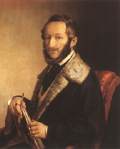
Miklós Barabás (1810-1896) was the first Hungarian painter who became really popular. He was the first painter who managed to live on painting in different genres and to apply various techniques. After his studies in Vienna, he went to Italy where he met an English watercolour painter. Thus, he learnt how to improve his style in it. He settled down in Pest in 1835 where he lived and worked the rest of his life. He painted and cut mostly portraits, e.g. portraits of major figures involved in the revolution of 1848 either in pictures or lithographs. He became a leading personality of Hungarian public life. His informal portraits delicately idealised are particularly rich in details of the head and the face. Poses of models show hardly any variety. Portrait of Mrs Bitó (1874), a picture with delicate harmony of colours which Barabás painted at old age has the same features. He was not particularly successful with group-portraits (The Family Bencsik) or genre pictures. The best known of his genre pictures is Rumanian Family Setting off to Market (1843). His landscapes portray the Great Plain genuinely and in an elevated style as in applied pictures or trade-signs. He prepared several sketches in 1842 when the foundation stone of the Chain Bridge was laid. The first small version - which is much higher in quality than the later large-size somewhat formal oil version - elevates at the first time an everyday event into the sphere of historical painting.
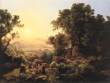 Károly Markó the Elder (1791-1860), the greatest landscape painter of the period, was a close friend of Barabás. Markó who wanted to be an engineer attended the Vienna Academy where he met Barabás, but he was in fact self-educated artist. After difficult years at the beginning marked by small size genre pictures full of emotion or allegory, he tried his hand at larger landscapes. He painted Visegrád, his best known picture, probably around 1830. The overview applied carefully and consequently, the contrast of light and shadow emphasizes this authentic picture from idyllic pictures popular at the time. As his laboursome pictures did not bring him enough income, he was forced to leave the country for Italy where he lived and worked the rest of his life except for some shorter intervals. Soon he made his name as a painter who united ideal landscape of academic composition with an authentic portrayal of nature. Careful composition, Arcadian atmosphere and lighting make his pictures different from the average. He always maintained contact with Hungary, he even toyed with the idea of returning. His impact was not too strong, yet timelessness raised him from his age and his style survived the second half of the century.
None of his contemporaries equalled Barabás either in the number of works or his success, or the charm and attraction of his pictures. Sándor Kozina (1808-1873), a prominent master of his time, was greatly appreciated for his delicately composed pictures in the court of the Russian tsar. Jakab Marastoni (1804-1860) of Venetian birth met with huge success which exceeded that of Kozina's. He passed the Italian style full of emotions on to a rather sentimental style of portraits and genre-pictures. His real significance lies in the fact that he founded a private art gallery in Pest in 1842 which was sponsored by the town. It worked for a period of ten years. His academy can be considered as the first Hungarian art academy. Mihály Zichy and Károly Lotz, among others, started their careers under Marastoni, which leads one to conclude that his skills and art were more significant and easier to pass on than his works, though few in number, would suggest.
Bálint Kiss (1802-1868) was a portrait painter, too. Kiss, a friend of Barabás, tried his hand at painting historical pictures inspired by his capacity as a guard at the Hungarian National Museum. Although János Jablonczay Pethes Bidding Farewell to his Daughter (1846) with an event from the 17th century which had reference to his age, was artistically rather poor, it brought him a lot of success. Kiss himself painted 20 copies of it which indicated that the picture was symbolic in a way. Of his portraits mention must be made of the one portraying Imre Székely, a pianist.
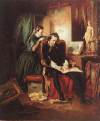 The best of all portrait and genre painters was József Borsos (1821-1883). His art was characteristic of impressive details, great artistic skills which he learnt at the Vienna Academy. It was Borsos who established genre pictures of an intimate and sentimental nature best suiting demands of the time. In the case of Portrait of Mátyás Zitterbach, Architect (1851) or Officer of the National Guard prove his skills at character portrayal and strict composition allowing him to create works monumental in effect. His works, however, are rather unbalanced in quality and lacking in harmony and steadiness typical of Barabás' personality and art. Of his genre pictures. Young Maids after the Ball (1851), a picture of excellent composition is worth mentioning. Its sentimentality and high artistic quality, makes one forgive that it does not reflect harsh conditions of the age. Borsos became more and more introverted, and the development and vigour of his art came to a standstill. He gave up painting altogether before very long, became engaged in photography and died as the director of Szép Juhászné (Beautiful Shepherdess), a restaurant.
Alajos Györgyi (Giergl) (1821-1863) failed to unfold his talent. In order to match the prevailing taste of his age, he decided to paint genre pictures (Surprised Admnirer) but he did not meet with success, although his genre pictures were full of humour and irony. After his trip to Italy (1857), he was engaged in painting portraits. The quality of the Portrait of Szidónia Deák (1861) is comparable with that of Borsos' best pictures.
Károly Brocky (1807-1856) who painted mostly genre pictures and portraits was obliged to leave Hungary where he could not earn his livelihood, and settle down in England to stay there for the rest of his life. He never broke off his ties with his country and maintained friendship with Hungarian exiles after the war of independence of 1849. His pictures characteristic of freshness and airiness recall memories of museums, and the choice of his subjects appear to be rather like baroque. His Self-Portrait (1850) and Girl Standing on Balcony are by far the best in artistic quality.
Neither public buildings, nor private residences required expensive sculptural decoration, but if they did, foreign masters were favoured of whom József Klieber (1773-1850) received a lot of commissions. Klieber, a professor at the Vienna Academy, was probably the first master of István Ferenczy. Klieber produced statues of kings for the library of Pannonhalma and mythological figures for the entrance room of the Festetich Palace in Budapest. Klieber presumably never visited Hungary, thus he influenced Hungarian art only indirectly.
Marco Casagrande (1805-1880), an artist from Venice, became integrated in the development of Hungarian art. He was invited to come to Hungary by János Pyrker, Archbishop of Eger, who commissioned him to decorate the Cathedral of Eger in 1833. His sculptures indicate artistic skills without any individual taste. The personal touch was more apparent in mythological reliefs which he completed for the Fáy Residence in Fáj or the concert hall of the Ullmann house in Pest after he had settled down in Pest in 1837. He modelled portrait sculptures, then sculptures for the Cathedral of Esztergom after 1841. Wherever he worked, he employed a number of assistants and apprentices, as a result he had a significant influence on future sculptors inexperienced in sculpture. After the war of independence of 1848 had been defeated, Casagrande received no more commissions, and, feeling discouraged, he returned to Italy. In 1856 he went to Eger once more to finish some of his statues. He had a major impact on Hungarian art although his works had no national character or contact to Hungarian traditions.
József Huber was an important figure of sculpture: he produced mainly tombs. His mourning figures were characteristic of careful composition and modelling with few types of figures, e.g. figures covered by mantles, leaning on an urn or holding a torch. However clumsy they were in comparison with figures of Casagrande, they appeared to be less formal.
Lőrinc Dunaiszky (1784-1833) with by far the most works, accepted all commissions and used all sorts of materials. He was extremely good at making pulpits, his special area, which, unfortunately brought him few commissions. Dunaiszky, one of the first artists to learn at the Vienna Academy and use the title of academic sculptor, had an important role in passing on principles of classicist sculpture of Vienna.
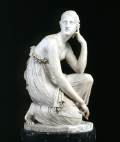
The most significant sculptor of this half century was István Ferenczy (1792-1858). His statue Shepherdess or as he preferred to call it, "Awakening of the Arts", may be regarded as the symbolic beginning of the revival of Hungarian sculpture. Ferenczy completed his Shepherdess while studying in Rome and sent it back to Hungary as soon as he had finished it. He considered himself to be the first in Hungarian national sculpture, and as such he had to create it. Ferenczy failed to realise his plan. (See details on the art of Ferenczy on separate page.) Depressed after his failure, he stopped working leaving works unfinished, and returned to his native Rimaszombat. Occasionally, he accepted commissions to produce sculptures which made him employ assistants, e.g. Miklós Izsó whose first master was Ferenczy.
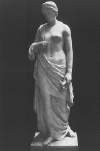 Members of the younger generation had high expectations. Rudolf Czélkuti-Züllich (1813-1890) and József Engel (1815-1901), both formal and trained artists, represented overdue academic sculpture without a personal or national touch. Czélkuti's Juno, however, met with praise indicating that society had been longing for a sculptor. After a favourable start, Czélkuti became discouraged and was engaged in in statuettes. He spent a good deal of his life in Rome until 1860. On his return to Hungary, the demand for memorials to be erected in public places urged Czélkuti to produce statues of József Katona and Sándor Kisfaludy, which, however, were so unsuccessful that, eventually, they had to be removed.
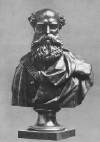 József Engel learnt sculpture abroad and settled down in Pest in 1869. His works came from the next decades. Károly Alexy (1823-1880), a sculptor of the mid 19th century, was a dynamic and ingenious master. Unfortunately, he did not receive significant commissions, so he modelled only small bronzes.
József Dániel Böhm (1794-1865), a medalist, spent most of his life in Vienna, where he was appointed to be the leader of the mint and where he trained generations of medalists. He never broke his contacts with Hungary, he created several medals portraying major figures of the time. He was in touch with a group of three scholars, Imre Henszlmann, Arnold Ipolyi and Flóris Rómer, representatives of art history, literature and protection of monuments, respectively, in the 40s.