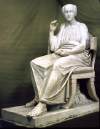
The most significant sculptor of the period was István Ferenczy, a dedicated artist, who considered himself to be the first in Hungarian national sculpture, and as such he had to create it. Ferenczy failed to realise his plan.
Returning from Rome (1824) where he studied for several years, he became a lonely artist without contact with the artistic life of the country. However, he was a typical figure of dedicated Hungarians of the so-called reform period who supported principles beyond him and was ready to sacrifice his life to accomplish his plans in favour of his country. He modelled several portraits of leading personalities of academic life. In some cases his portraits were true character portrayals, e.g. the half-length portrait of Ferenc Kazinczy, not free from idealism of the age. Of his tombs, simple memorials were more successful, e.g. that of the Kulcsár family, sepulchral chapels, on the other hand, did not match his talent, e.g. that of the Rhédey family.
He was aspiring after a significant commission all his life, this is why he refused offers to decorate buildings which would have contributed to his livelihood. Instead, he had noble object in view, e.g. he searched for marble in Hungary which he discovered in Ruskica, and founded the first workshop in Buda to cast bronze as he planned to create the Matthias Memorial. Memorials had not been erected in public places before. It was Mihály Vörösmarty the poet who supported the campaign to raise funds for the Matthias Memorial, a memorial for one of the greatest kings of Hungary.
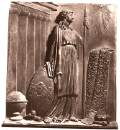 Sketches of Ferenczy proved to be unsuccessful, thus he was never given the commission. He was so deeply grieved over it that the success which the life size statue of Kölcsey brought him later could never make him forget his failure. Depressed, he stopped working leaving works unfinished, and returned to his native Rimaszombat where he was engaged in the implementation of his mechanical solutions. Occasionally, he accepted commissions to produce sculptures which made him employ assistants, e.g. Miklós Izsó whose first master was Ferenczy.
 Previous page