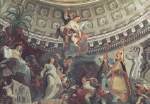
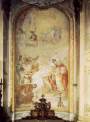
 The best works of baroque painting and sculpture are always associated with architecture. Important buildings - whether secular or ecclesiastical - could not do without them. Sculpture and painting did not serve merely decorative purposes, but they had a message which architecture failed to pass on to average citizens. Large scale frescoes were generally entrusted to masters from abroad of whom Franz Anton Maulbertsch (1724-1796) was the most significant one. He created his major works in Hungary. His earliest work was a fresco for the parish-church in Sümeg, one of the most significant works of the period, which covers the walls and the ceiling of the church. The master included his self-portrait in the fresco of the chorus. He painted himself in the company of men in Hungarian costumes.
 Maulbertsch created several works in Hungary, e.g. the ceiling fresco for the Cathedral of Győr and the legend of Stephen, a martyr, in the master's version for the parish-church in Pápa. Like painting from the 70s, pictures of Maulbertsch also became more peaceful or formal in a way. Art is under the influence of enlightenment which made it break with pathos and illusions of baroque. He could not finish his last commission, frescoes for the Cathedral in Szombathely: it was Winterhalter (1743-1807), his pupil, who completed it following the original sketches.
Maulbertsch was one of the most significant and individual of all fresco painters, but there were, of course, several excellent painters working in Hungary before and after him: e.g. Paul Troger (1698-1762) painted frescoes for the church of nuns of the Elizabeth-order in Pozsony and for the Jesuit Church in Győr as well as Johann Ignac Cimbal, an artist from Vienna, worked in the episcopal see in Veszprém, in the Cathedral of Székesfehérvár and in several castles. Cimbal used to work more in Hungary than in his country.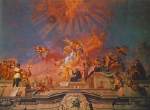 Johann Lucas Kracker exceeded him in significance: he settled down in Hungary and worked in Jászó and Eger. Large scale building by Károly Esterházy had a significant influence on the artist who painted frescoes and altar pieces like most artists. Kracker painted frescoes, his major work was a fresco for the library of College in Eger. Franz Sigrist (1727-1803) painted frescoes of the four faculties for the Main Hall of the College.
The last artist to close the line of painters was István Dorffmaister. He was the head of a family of painters who worked in the west of Hungary. His works, including altarpieces, were of changing quality. It was Dorffmaister who arrived at historic subjects e.g. in frescoes (1788) for the parish-church in Szigetvár where he painted the death of Zrinyi. His frescoes were lighter and brighter in colour, vivid and dynamic accompanied by excellent illusions, qualities typical of monumental painting.
Although painters of monumental frescoes accomplished altar pieces, too, Dorffmaister was the first to focus on panel pictures as a secular genre. Portraits became of particular importance. In addition to Buda, Sopron and Pozsony, Győr and Kassa started to grow into major centres and to entrust tasks to local and foreign masters, or even complete families of artists, e.g. the Schaller family which worked in Sopron and the west of Hungary, or the Scherwitz family which worked in and around Buda. Landscapes representing a secular genre started to develop at the time. Károly Schallhas (1769-1797), a landscape painter of the period, produced pictures with an intimate approach both in size, colours and composition.
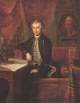 The most typical secular genre was the portrait represented by the Falkoner family of Sopron, Zsigmond Falusy of Győr or Sámuel Horváth of Pest. Their activities lead to the conclusion that citizens of towns came to like portraits as they were considered to strengthen and prove the social status of citizens in town. Thus, it is not surprising that several portrait painters used to work in the Protestant Transylvania, e.g. the Stock family in Nagyszeben, of which János Márton Stock (1742-1800) produced pictures in particularly large numbers and high quality. His pleasant, somewhat idealising portraits with familiar looking landscapes in the background are features characteristic of his painting. Pictures showing events and still-lifes of a somewhat primitive nature appeared in the period, thus creating a link to classicist painting of the 19th century.
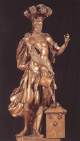 The connection of sculpture with architecture was much stronger than that of painting, e.g. statues for altars, pulpits or complete altars. The majority was produced by wood cutters rather than stone cutters who applied the techniques of colouring and gold plating on stuccoes instead of wood. They were marked by dynamism, effective composition, colours and drama especially in mature baroque works. Compositions included the informal style of Italian painters, e.g. Károly Bebo (1712-1779) commissioned mainly by the Zichy family produced the pulpit and altar statues for the St. Anne Church and St. Elizabeth Church in Buda. Bebo also worked as a stone cutter.
Works of excellent quality are associated with the name of Johann Anton Krauss (1728-1795). Drama and dynamism made his statues for churches theatrical, e.g. the high altar in the former Jesuit Church in Eger where St. Francis of Borgia is kneeling in front of the Holy Sacrament. His figure and the folds of his clothes are by Kracker in the Premonstrant Church in Jászó.
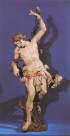 Unfortunately, the majority of altars in churches in Hungary are works of unknown masters. There are, however, some more names representing ecclesiastical sculpture in Hungary. József Hebenstreit (1719-1783), a stone and wood cutter, produced altars e.g. for the St. Francis Church (1777), a Franciscan church in Szécsény, or statues of the high altar in the Minorite Church (1769) in Eger. The excellent statues of St. Sebastian and St. Roch from Egervár are the mature works of the Austrian artist Philipp Jakob Straub (1706-1777). Lajos Gode used to work in Pozsony and Győr in the mid 18th century, József Hartman (1700-1764) in Upper Hungary, János Nachtigall (around 1717-1761) and Antal Schuchbauer (172-1776) in Transylvania, significant sculptors of statues for churches. The most beautiful example for harmonious interior design (altar frames, pulpit, organ-loft and benches) is associated with the name of Brother Sebestyén Stuhlhoff (1753).
Altars containing elements of architecture only became particularly popular under the influence of enlightenment in the late 18th century, e.g. Hildebrand's high altar (1772-1775) for the Cathedral of Székesfehérvár, which is the best work of the master and the period.
Ecclesiastical sculptures erected in public places were particularly popular all through the 18th century (Columns of Mary and Trinity Memorials) which were accomplished by Italian masters in the early 18th century. The Trinity Memorial (1755-1766) in Selmecbánya and the Column of Mary (1764) in Körmöcbánya are the works of Dionisio Stanetti (died in 1767) who used to work in the region. Bebo, too, modelled a Trinity Monument for Óbuda. Artists of the genre consisted mostly of German masters, e.g. Jakob Christian Schletterer (1699-1774) who produced a Column of Mary for Sopron in 1745, or Martin Vögerl (1714-1770).
The Trinity Monument in Buda (1712-1715) is the product of Fülöp Ungleich and Antal Hörger who worked e.g. on the Florian Group and the Church in the city of Pest. Statues, especially those of St. John of Nepomuk and St. Roch were erected by bridges and roads until the end of the century, some of them with characteristics of folk-art, e.g. calvaries over the country. The artistically most significant of them is the Calvary (1744-1749) by Hildebrandt and András Mayerhoffer today in the Epreskert in Budapest.
Works of secular sculpture are fewer in number. Most of them framed entrance doors of town palaces and castles in the country with figures and ornaments. Ceilings of castles and palaces required plaster decoration present on quite a few houses in towns.
Several stone cutter families used to work in Hungary who were entrusted mostly with ecclesiastical tasks. Carlo Adami was one of the most significant of them who worked for the middle classes of Buda at the end of the 18th century Unfortunately, of his fountain figures only the figure of Athene survived to prove his delicate composition skills. Gardens of French style around castles where principles of English landscape gardening were soon followed, demanded more and more sculptures by the end of the century which were produced by masters from Austria exclusively.
Only few tombs have survived. As they were rather expensive, few artists were commissioned to complete them, and, as a result, sculpture of this genre could not evolve either.
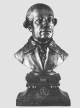 Portrait sculpture made its first attempts at the time. Demand for it was low anyway, but if there was any, portrait sculptures were imported from German territory. Franz Xaver Messerschmidt (1736-1793), a renowned artist from Austria, had a major influence on the development of Hungarian portrait sculpture: he spent the last six years of his life in Pozsony where he completed a series of physiognomic studies and portraits, e.g. the bust of György Kovachich (1782). Hungarian portrait sculpture appeared probably on his influence, an early example for it is the Self-Portrait (1796) of Antal Marschal.
| Top |